

(UroToday.com) The 2026 APCCC meeting featured a management of metastatic hormone sensitive prostate cancer (mHSPC) session and a presentation by Dr. Susan Halabi discussing radiographic progression free survival as a surrogate for hard endpoints in mHSPC. Overall survival is the gold standard for prostate cancer patients, but it is increasingly delayed and confounded by crossover and subsequent therapies. Radiographic progression free survival is widely used as a primary endpoint in mHSPC, which enables earlier assessment of efficacy in this disease space. The key question, according to Dr. Halabi, is: Does radiographic progression free survival reliably capture treatment benefit in overall survival?
There are several regulatory requirements and expectations noted by Dr. Halabi:
- Strength and consistency of evidence: regulators expect a reasonable association and consistent direction of effects
- Context of use matters: mHSPC line of therapy and drug class (ie. androgen receptor pathway inhibitor, ADT + androgen receptor pathway inhibitor)
- Overall survival confirmation: regulators expect confirmation of long-term benefit
- Transparency and robustness: sensitivity analyses for crossover, subsequent therapies, and proportional hazards violations
For proving a surrogate endpoint, Dr. Halabi notes that there is a state of the art two stage validation approach:
- Patient level: surrogate and true endpoint correlated
- Trial level: treatment effect on surrogate and overall survival endpoints correlated
Statistically, true surrogacy requires both individual level and trial level association, with most challenges arising at the trial level. Individual patient data is the preferred level of evidence for these assessments. In 2024, Dr. Halabi and colleagues1 investigated whether radiographic progression free survival and clinical progression free survival are valid surrogates for overall survival in men with mHSPC. For this study, they used individual patient data from 9 eligible randomized trials comparing treatment regimens (different ADT strategies or ADT + docetaxel in the control or research arms) in mHSPC. These results are as follows:
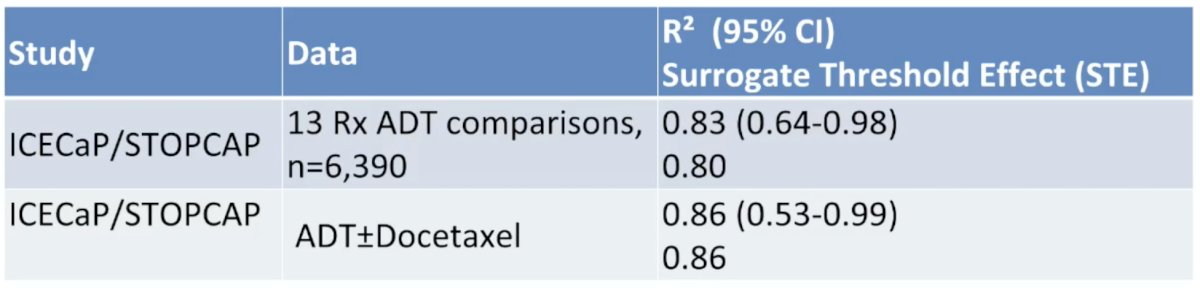
Surrogate threshold effect reflects how large the radiographic progression free survival effect would need to be to reliably predict an overall survival benefit. Based on the above surrogate threshold effects, this study concluded that both radiographic and clinical progression free survival appear to be promising surrogate endpoints for overall survival.
Dr. Halabi concluded her presentation discussing radiographic progression free survival as a surrogate for hard endpoints in mHSPC with the following take-home points:
- Radiographic progression free survival shows partial surrogacy in mHSPC, with the strongest for patients receiving ADT +/- docetaxel
- Radiographic progression free survival is not a fully validated surrogate for overall survival, particularly in androgen receptor pathway inhibitor and ADT +/- androgen receptor pathway inhibitor treatment regimens
- Confirmation of overall survival remains essential
- Regulatory acceptance depends on context of use:
- Class of therapy (androgen receptor pathway inhibitor, ADT +/- androgen receptor pathway inhibitor)
- Follow-up maturity
- The post-progression treatment landscape
Presented by: Susan Halabi, PhD, FSCT, FASA, FASCO, Duke University, Durham, NC
Written by: Zachary Klaassen, MD, MSc – Urologic Oncologist, Associate Professor of Urology, Georgia Cancer Center, Wellstar MCG Health, @zklaassen_md on Twitter during the 2026 Advanced Prostate Cancer Consensus Conference (APCCC), Lugano, Switzerland, Thurs, April 30 – Sat, May 2, 2026.
References: