

(UroToday.com) The 2025 PSMA and Beyond annual meeting featured an alpha and other radionuclides session and a presentation by Dr. Alfred Morgenstern discussing 212Pb-PSMA versus 225Ac-PSMA. Dr. Morgenstern started his presentation by emphasizing that 212Pb versus 225Ac are two promising alpha emitters:

The supply of 212Pb comes from 228Th via extraction from natural ore and from neutron irradiation of 226Ra:

There are several generator principles for 212Pb:
- Extraction from 228Th solutions requires an industrial environment
- 228Th/212Pb generators via emanation of 220Rn are potentially useful in hospital settings
- 224Ra (3.6 days)/ 212Pb generators is easier for distribution, but only for short use
- The 10.6 hour half-life of 212Pb allows for centralized GMP production and distribution of 212Pb radiopharmaceuticals
Dr. Morgenstern emphasized that alpha emitters induce a strong immune response but with a 22.5 times shorter half-life of 212Pb compared to 225Ac. Thus, it is a good match for pharmacokinetics of many ligands. 212Pb has a more rapid deposition of dose and production of radicals, but what are the differential effects on immune response activation?
Pathway analysis has identified biological pathways modulated after 212Pb-ADVC001 treatment, with (i) early response – DNA damage repair, and cell cycle, growth and metabolism; (ii) intermediate response – DNA damage repair, and cell cycle, growth and metabolism, immune response regulation, and cell senescence and death; and (iii) late response – other signaling (resistance?):

Additionally, pathway analysis reveals very similar pathways dysregulated in 177Lu- and 212Pb-PSMA treated tumors. 212Pb-PSMA affects pathways unaffected by 177Lu-PSMA, including several related to cell cycle regulation. Dr. Morgenstern then discussed the following table of clinical studies using 212Pb in prostate cancer:

Published on March 13, 2025, Berner and colleagues1 reported a first-in-human phase 0 study of AB001, a PSMA-targeted 212Pb radioligand among patients with mCRCP. The primary objective was the feasibility of gamma-camera imaging to assess biodistribution and uptake in metastatic lesions. A low dose of 9.4 +/- 0.3 MBq of AB001 was administered to 3 patients and found to be safe, and stable in vivo, and imaging was feasible but needs further investigation. Phase I studies are in preparation with a higher dose:


A phase I/II trial of 212Pb-ADVC001 is currently enrolling at 60 MBq, 120 MBq, and 200 MBq, with no signs of myelosuppression and no grade 3 symptomatic adverse events. There has been low salivary gland uptake, with only grade 1 xerostomia, and no treatment discontinuation. The trial design is as follows:

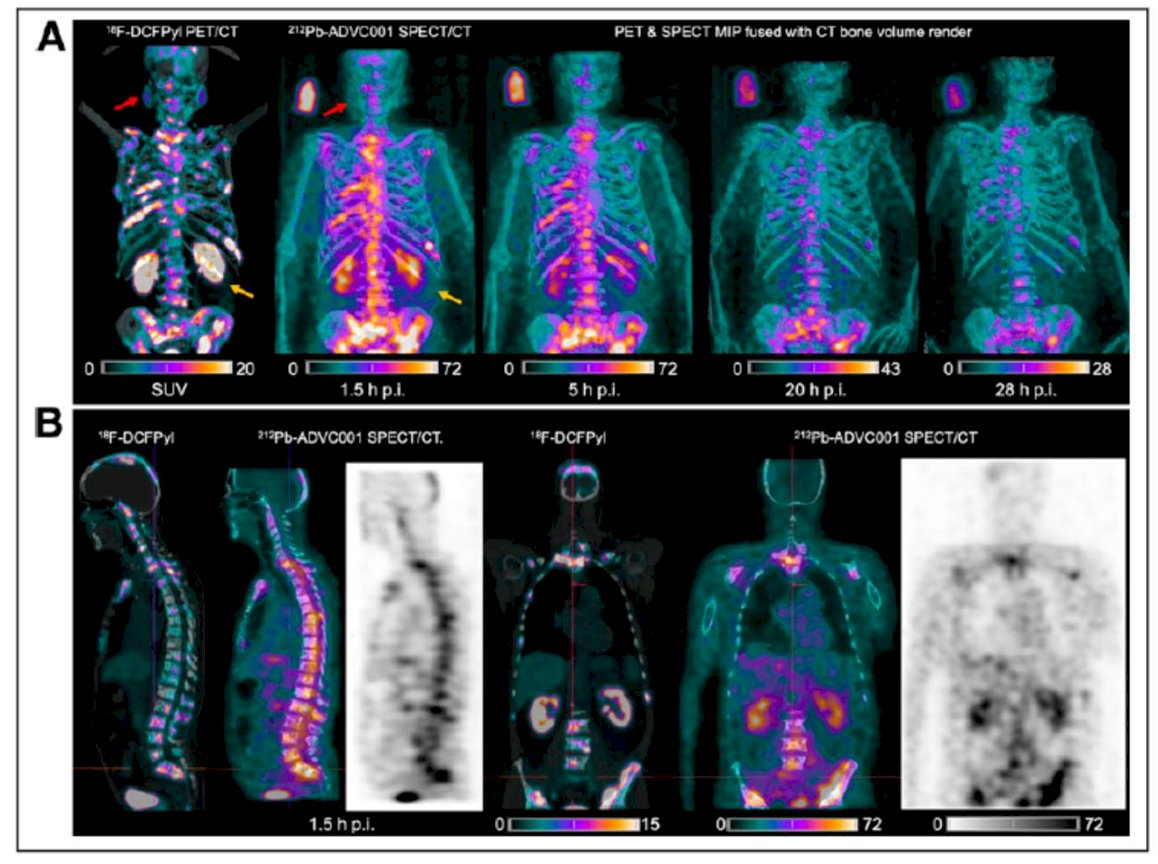
212Pb-ADVC001 at 60 MBq was initially reported in April 2024 [2], showing low salivary gland uptake and rapid kidney clearance:
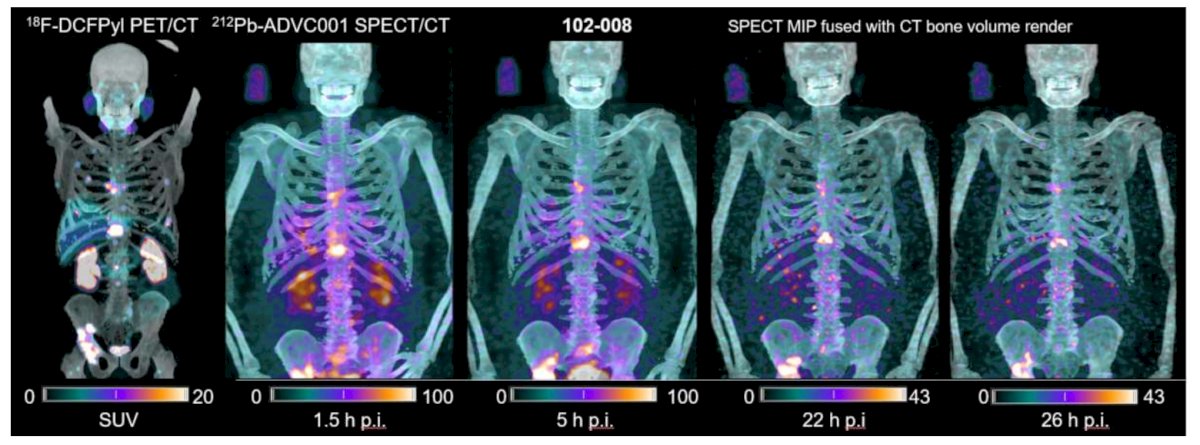
Even at 160 MBq, 212Pb-ADVC001 shows favorable biodistribution with low salivary gland uptake:
Dr. Morgenstern concluded his presentation discussing 212Pb-PSMA versus 225Ac-PSMA with the following take-home points:
- 225Ac-PSMA and 212Pb-PSMA are promising compounds for therapy of prostate cancer
- The therapeutic efficacy of 212Pb-PSMA is still under investigation
- Half-lives of 212Pb (10.6 hours) and 225Ac (9.9 days) allow for combination with ligands of different pharmacokinetics
- Securing a supply of 212Pb and 225Ac is crucial for further development
Presented by: Alfred Morgenstern, PhD, Joint Research Centre, Karlsruhe, Germany
Written by: Zachary Klaassen, MD, MSc – Urologic Oncologist, Associate Professor of Urology, Georgia Cancer Center, Wellstar MCG Health, @zklaassen_md on Twitter during the 2025 PSMA and Beyond Annual Meeting, Los Angeles, CA, Fri, Mar 28 – Sat, Mar 29, 2025.
References:
- Berner K, Hemes E, Kvassheim M, et al. First-in-human phase 0 study of AB001, a prostate-specific membrane antigen-targeted 212Pb radioligand, in patients with metastatic castration-resistant prostate cancer. J Nucl Med. 2025 Mar 13 [Epub ahead of print].
- Griffiths MR, Pattison DA, Latter M, et al. First-in-human 212Pb-PSMA-Targeted alpha-therapy SPECT/CT imaging in a patient with metastatic castration-resistant prostate cancer. J Nucl Med. 2024;65(4):664.