

(UroToday.com) The 2025 PSMA and Beyond annual meeting featured a PSMA session and a presentation by Dr. Amir Iravani discussing the landscape of approved PSMA imaging agents. Over the last several years, we have certainly seen an accelerated evolution of PSMA imaging agents:

In the initial staging setting, when assessing the UCSF/UCLA 68Ga-PSMA-11 trial,1 the OSPREY 18F-DCFPyL trial,2 and the LIGHTHOUSE 18F-rhPSMA 7.3 trial,3 Dr. Iravani notes that there is very similar sensitivity and specificity between the three agents:

There are several noteworthy points with regards to initial staging, including (i) PSMA PET is highly specific, (ii) PSMA PET N0 is not necessarily pN0 (modest sensitivity for detection of N1 disease), (iii) the larger the nodes, the higher the accuracy of PSMA PET (the size of lymph nodes matters), (iv) even histopathology as standard of truth is not perfect, and (v) the higher the risk of prostate cancer, the higher the detection rate.
In the biochemical recurrent setting, when assessing the UCSF/UCLA 68Ga-PSMA-11 trial,4 the CONDOR 18F-DCFPyL trial,5 and the SPOTLIGHT 18F-rhPSMA 7.3 trial,6 Dr. Iravani notes that there is very similar positive predictive value among the three agents:

There are also several noteworthy points with regard to biochemical recurrence, including (i) substantial inter-reader agreement, (ii) higher detection rate at higher PSA levels, (iii) using a less sensitive test as standard of truth affects endpoints, and (iv) high detection rate at very low PSAs (<0.5 ng/mL).
For assessing rhPSMA-7.3 and urinary excretion, Kuo and colleagues7 did a post hoc analysis of the LIGHTHOUSE and SPOTLIGHT studies. They found that by majority read, 96% of patients had either no urinary activity or visible activity that could be distinguished from disease uptake. In the minority of patients (3.4%) urinary activity did impact assessment:

Regarding PSMA agents in clinical trials, there are two 64Cu agents currently under investigation, 64Cu PSMA I&T and 64Cu-SAR-BisPSMA. The advantage of copper is a longer half-life, longer shelf life, delayed imaging up to 24 hours, as well as potential theranostic applications for 64Cu/67Cu. 64Cu PSMA I&T was assessed in a phase 1-2 trial of 26 patients with metastatic prostate cancer, meeting its endpoint of region-level and patient level correct detection rate. Solar-Stage (NCT06235151) is phase 3 trial assessing 64Cu PSMA I&T in unfavorable intermediate to high risk prostate cancer, and Solar-Recur (NCT06235099) is a phase 3 assessing 64Cu PSMA I&T in biochemical recurrence. 64Cu-SAR-BisPSMA was assessed in the phase 1 PROPELLER trial assessing 30 patients undergoing initial staging, and CLARIFY (NCT06056830) is a phase 3 trial assessing 64Cu-SAR-BisPSMA in unfavorable intermediate risk prostate cancer. COBRA was a phase 1-2 trial that assessed 64Cu-SAR-BisPSMA in 50 patients with biochemical recurrence, and AMPLIFY is a phase 3 trial assessing 64Cu-SAR-BisPSMA in biochemical recurrence.
Dr. Iravani then discussed patient selection for PSMA radioligand therapy. Several studies have assessed patient selection using either 68Ga-PSMA-11 or 18F-DCFPyL. Generally, there is similar normal tissue and lesion uptake between the two tracers and similar normal tissue distribution. What matters the most is that PSMA PET is more accurate than conventional imaging at various prostate cancer stages:

PSMA PET has led to more upstaging and downstaging of patients, in addition to refining and redefining disease state and risk groups. Undoubtedly, clinical adoption has outpaced evidence generation for outcomes. The quality of the scan and interpretation leads to sensitivity and specificity regardless of the tracer:
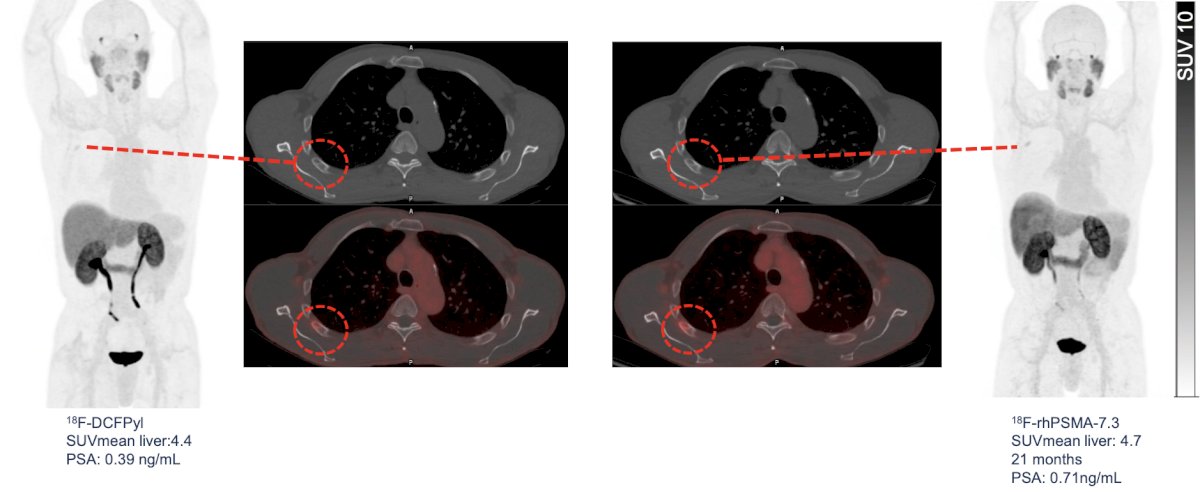
Dr. Iravani concluded his presentation by discussing the landscape of approved PSMA imaging agents with the following take home points:
- Does it matter what agent to use? For the most part, it does not, but we should not compromise on the quality of interpretation
- There are similar performance characteristics of all three PSMA PET agents in initial staging and biochemical recurrence. Perhaps there is lower urinary excretion of rhPSMA-7.3, but the clinical impact to date is indeterminable
- We should use what is available and consider logistical issues at the institution
- For patient selection for PSMA radioligand therapy, all three can be used, but we must pay attention to the liver uptake with rhPSMA-7.3
Presented by: Amir Iravani, MD, University of Washington, Seattle, WA
Written by: Zachary Klaassen, MD, MSc – Urologic Oncologist, Associate Professor of Urology, Georgia Cancer Center, Wellstar MCG Health, @zklaassen_md on Twitter during the 2025 PSMA and Beyond Annual Meeting, Los Angeles, CA, Fri, Mar 28 – Sat, Mar 29, 2025.
References:
- Hope TA, Eiber M, Armstrong WR, et al. Diagnostic Accuracy of 68Ga-PSMA-11 PET for Pelvic Nodal Metastasis Detection Prior to Radical Prostatectomy and Pelvic Lymph Node Dissection: A Multicenter Prospective Phase 3 Imaging Trial. JAMA Oncol. 2021 Nov 1;7(11):1635-1642.
- Pienta KJ, Gorin MA, Rowe SP, et al. A Phase 2/3 Prospective Multicenter Study of the Diagnostic Accuracy of Prostate Specific Membrane Antigen PET/CT with 18F-DCFPyL in Prostate Cancer Patients (OSPREY). J Urol. 2021 Jul;206(1):52-61.
- Surasi DS, Eiber M, Maurer T, et al. Diagnostic performance and safety of positron emission tomography with 18F-rhPSMA-7.3 in patients with newly diagnosed unfavorable intermediate- to very-high-risk prostate cancer: Results from a Phase 3, Prospective, Multicenter Study (LIGHTHOUSE). Eur Urol. 2023 Oct;84(4):361-370.
- Fendler WP, Calais J, Eiber M, et al. Assessment of 68Ga-PSMA-11 PET Accuracy in Localizing Recurrent Prostate Cancer: A Prospective Single-Arm Clinical Trial. JAMA Oncol 2019 Jun 1;5(6):856-863.
- Morris MJ, Rowe SP, Gorin MA, et al. Diagnostic Performance of 18F-DCFPyL-PET/CT in Men with Biochemically Recurrent Prostate Cancer: Results from the CONDOR Phase III, Multicenter Study. Clin Cancer Res. 2021 Jul 1;27(13):3674-3682.
- Jani AB, Ravizzini GC, Gartrell BA, et al. Diagnostic performance and safety of 18F-rhPSMA-7.3 positron emission tomography in men with suspected prostate cancer recurrence: Results from a phase 3, prospective, multicenter study (SPOTLIGHT). J Urol. 2023 Aug;210(2):299-311.
- Kuo PH, Hermsen R, Penny R, et al. Quantitative and qualitative assessment of urinary activity of 18F-Flutofolastat-PET/CT in patients with prostate cancer: A post-hoc analysis of the LIGHTHOUSE and SPOTLIGHT studies. Mol Imaging Biol. 2024 Feb;26(1):53-60.