

(UroToday.com) In a moderated poster presentation at the 2022 American Urologic Association Annual Meeting held in New Orleans and virtually, Dr. Robesti discussed the role of concomitant androgen-deprivation therapy (ADT) in patients undergoing image guided therapy (IGT) for 68Ga-PSMA PET/CT detected recurrence disease following radical prostatectomy. While there has been literature demonstrating a benefit to the addition of ADT to salvage radiotherapy, no study has addressed the role of this combined treatment approach in patients with recurrence disease diagnosed by 68Ga-PSMA PET.
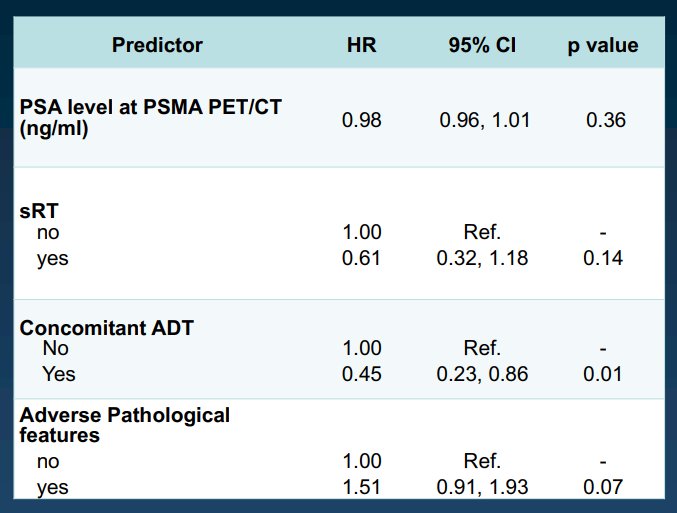
The authors retrospectively identified 207 patients who underwent 68Ga-PSMA PET/CT for BCR after RP between 2016 and 2021. Among these, the authors selected patients with a positive PSMA PET and who subsequently received IGT. They examined the primary outcome of early clinical recurrence (CR), defined as any new metastases detected at imaging within 2-years after a first PSMA PET/CT. Among these patients, the authors used multivariable Cox regression to assess the association of ADT plus IGT (compared to IGT alone) in men with positive PSMA PET/CT on risk of CR, after adjusting for PSA at PSMA PET/CT, adverse pathological features (i.e. Grade Group 4-5 with ≥pT3a stage and/or lymph node invasion) and use of sRT. Multivariable Cox-derived Kaplan-Meier (KM) analyses depicted the time from the first scan to CR and progression to CRPC.
Among the 207 initially identified patients, 104 patients had a positive PSMA PET scan and received IGT. Median PSA at PSMA PET/CT was 0.6 ng/ml and 41 patients experienced disease progression. Overall, 76 (59%) received ADT while the remainder received IGT alone. The decision to use ADT was left at the discretion of each treating physician. No differences were observed in terms of adverse pathology features and rate of salvage RT or IGT use between those patients who received ADT with IGT and those who received IGT alone (all p ≥0.1).
Over a median follow-up of 18 months after the PSMA PET/CT, the overall 2-year CR-free survival and CRPC-free survival rates were 60% and 91% from the time of BCR, respectively. Using multivariable analyses, concomitant ADT use at the time of salvage treatments was associated with reduced risk of CR (HR 0.45, p=0.01), after adjusting for confounders.
Using Cox derived adjusted Kaplan Meier analyses, the 2-year CR-free survival were, respectively, 91 vs 60% in patients receiving ADT vs those patients not receiving ADT.
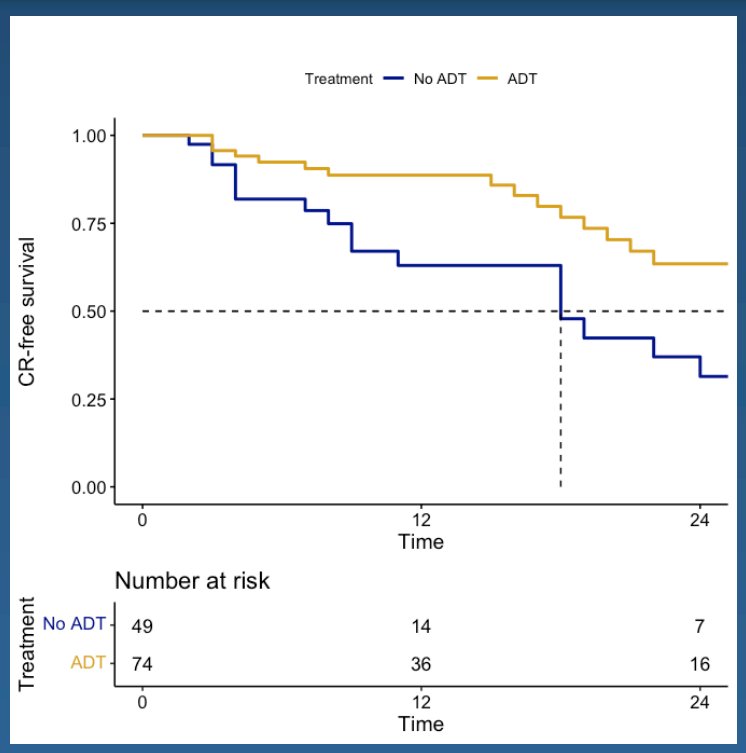
The authors conclude that concurrent use of ADT during PSMA-PET/CT guided IGT for recurrent prostate cancer is associated with a decreased risk of metastatic progression.
Presented by: Daniele Robesti, MD Vita-Salute San Raffaele University