

(UroToday.com) Shannon McNall and team presented a thought-provoking study that investigated prostate cancer treatment. External beam radiotherapy (EBRT) is a common treatment for prostate cancer. This procedure is performed among 1/3 of prostate cancer cases for men in the United States. With treatment, mortality rates for prostate cancer decrease which puts an emphasis on a treatment’s side effects. The International Prostate Symptom Score (IPSS) is a widely used tool among urologists. It helps with screening, diagnosing, and management of benign prostatic hyperplasia (BPH) and urinary function. To examine the effects of EBRT on men with this condition, McNall’s team used the IPSS to measure patient urinary symptoms.
For this study, the team retrospectively examined cases of patients treated with radiotherapy at seven centers of Advanced Radiation Centers in New York over the course of 11 years, 2006 to 2017. An IPSS score was taken at baseline before treatment and after treatment every six months to assess the efficiency of the treatment. Patients were treated with volumetric arc radiotherapy based on CT scans. During the course of nine to ten weeks, patients absorbed 81-86Gy doses to the prostate fin 45-48 fractions. Patients who were considered as high risk also revied pelvic noted radiotherapy and androgen deprivation therapy (ADT helps reduce androgen hormones with the intent to halt the growth of prostate cancer cells). The sum of the factors associated with IPSS that were considered included: grade group, age, pelvic lymph node EBRT (for high-risk patients), treatment stage, and the use of pelvic lymph node radio therapy and ADT.
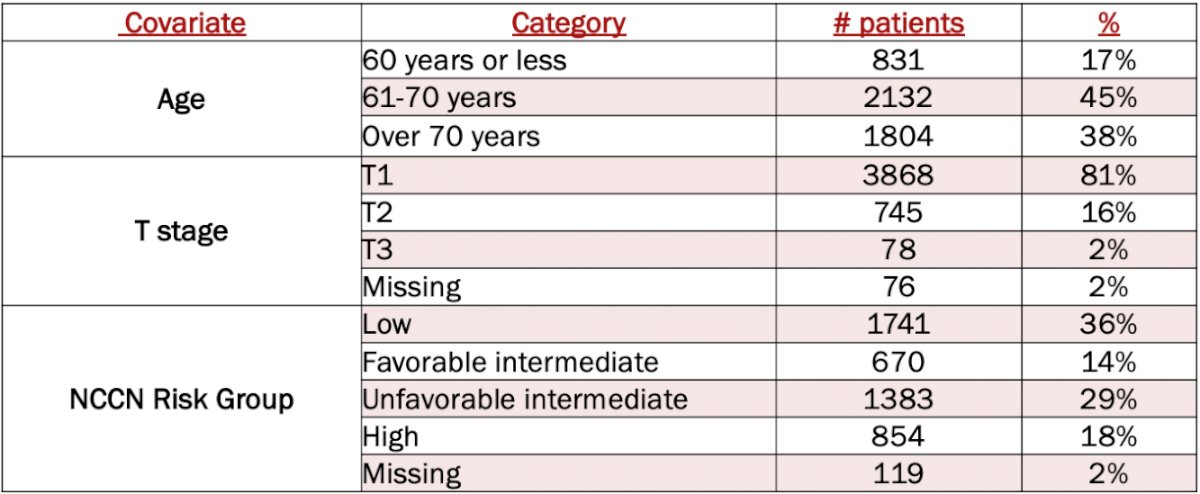
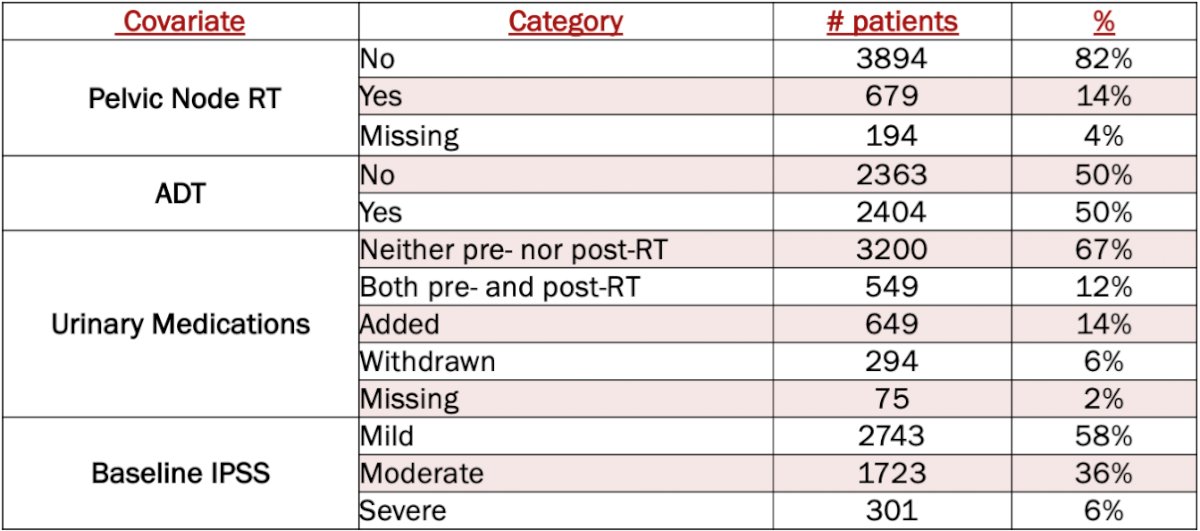
A total of 4,772 men were examined who had their baseline IPSS recorded before EBRT and 6-18 months after EBRT. The two tables table below show characteristic data of the participants.
The results demonstrated that urinary function slightly improved after EBRT. Patients with severe baseline urinary symptoms showed the most improvement, as seen in the table below.

The most statistically significant factor related to treatment was age. About 44% of men above the age of 60 and 36% less than 60 displayed moderate to severe baseline urinary symptoms prior to EBRT. Patients who underwent pelvic lymph node EBRT experienced a decrease in urinary function. Compared to those who did not receive pelvic lymph node EBRT, these patients had higher moderate to severe urinary function post EBRT, 45% to 37% respectively.
This study demonstrates how effective EBRT is for patients with prostate cancer. The IPSS showed that men with localized prostate cancer and moderate to severe urinary symptoms stand to improve the most after receiving EBRT. This form of therapy, shown in the table below, is not as effective for those with none to mild symptoms, as their IPSS scores increased.

A question was raised after the presentation regarding the change in IPSS scores for the moderate and severe symptoms; the audience member asked McNall why there was such a change in IPSS scores post treatment. McNall stated that radiation can cause scarring and shrinkage of the prostate; those with aggressive cancer and larger prostates therefore the impact of the treatment would be greater for these patients. A follow up discussion with the moderators brought up the work of Dr. Gregory Merrick who observed a similar trend to McNall’s findings. One other notable question brought up by an audience member was specific to IPSS and asked if the questionnaire was used. McNall acknowledged that she and her team discussed at length which questionnaire would most accurately fit their study and concluded that the IPSS did cover and assess all the factors they wanted to track in the patients. Actively applying the IPSS to prostate cancer patients undergoing EBRT is very helpful as it can help manage expectations of what EBRT can do for the patient.
Presented by: Shannon McNall, MD, BS, New York Medical College
Written by: Seyed Amiryaghoub M. Lavasani, B.A., University of California Irvine, @amirlavasani_ on Twitter during the 2022 American Urological Association (AUA) Annual Meeting, New Orleans, LA, Fri, May 13 – Mon, May 16, 2022.