

(UroToday.com) The 2022 American Urological Association (AUA) Annual Meeting included a session on detection and screening of prostate cancer and a presentation by Dr. David Kuppermann discussing prostate biopsies targeted to PSMA foci. PSMA PET imaging is the most accurate imaging method known for detection of metastatic prostate cancer, but may also be useful for detecting intra-prostatic cancer. 68Ga-PSMA scanning was approved by FDA in December 2020 for pre-op staging of prostate cancer and to detect possible recurrence. Currently, MRI-guided biopsy is the preferred method for diagnosis of prostate cancer, but prostate cancer may be MRI-invisible in 15-20% of cases. In this study presented at the AUA 2022 meeting, Dr. Kuppermann and colleagues evaluated intra-prostatic PSMA focal uptake as a target for biopsy detection of prostate cancer using PET/CT-US fusion (PSMA-guided biopsy).
In a prospective trial, 13 men underwent PSMA PET/CT imaging prior to fusion biopsy at UCLA. These men had a negative prior biopsy (10 MRI-guided biopsy), but continued clinical suspicion of prostate cancer and focal uptake of PSMA in the prostate. The method of PSMA-guided biopsy was identical to MRI-guided biopsy1 but employs US fusion with PET/CT instead of MRI, as detailed previously.2 The method of Ga-PSMA image acquisition via PET/CT scanning has also previously been reported.3 Contouring of intra-prostatic foci of PSMA positivity was performed via Profuse software by co-author Dr. Jeremie Calais. Image fusion & trans-rectal targeted biopsy was via Artemis device, and detection rate of clinically significant prostate cancer (> Gleason Group 2) by PSMA-guided biopsy was the primary endpoint. As follows is an example of a PSMA-guided prostate biopsy in a 71 year old man with a PSA of 8.5 ng/mL and prostate volume of 25 cc. MRI and systematic biopsy were negative (a), and PSMA PET/CT showed two 68Ga-PSMA-expressing lesions in the prostate (b). CT overlay identified intra-prostatic lesions which were contoured (c), and combining PET/CT with real-time ultrasound allowed a targeted biopsy using image-fusion technology (d). Biopsies of the larger lesion revealed Grade Group 3 prostate cancer: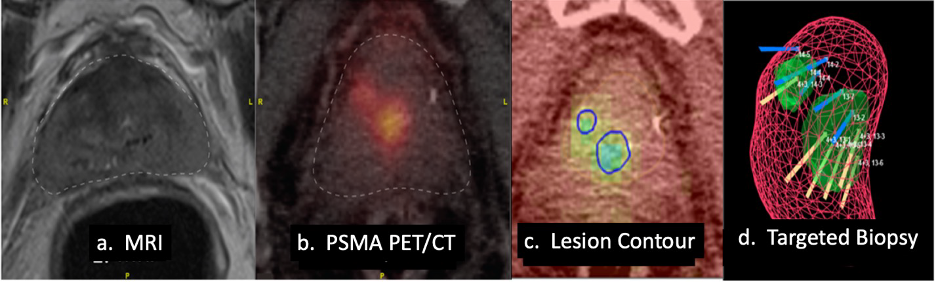
The median age of patients in this study was 71 years of age, median prostate volume was 27.7 cc (IQR 22.1, 38.3), and median PSA density was 0.25 ng/ml/cc (IQR 0.10, 0.45). PSMA-guided biopsy was successfully completed in all 13 men with no more difficulty than usual MRI-guided biopsy. The overall detection rate was 9/13 (70%): GG2 in 1 patient, GG3 in 6 patients, and GG4 in 2 patients. The maximum cancer core length was 4 mm median (IQR 3, 9). There were 4 PSMA foci that were anterior and all 4 contained clinically significant prostate cancer. The median SUVmax (standardized uptake value) was 6 in PSMA lesions returning <GG1 findings versus 8.2 in men with clinically significant prostate cancer. The median PSA density was higher in men with clinically significant prostate cancer (0.25) than others (0.20). Furthermore, among 5 men with prior radiation, 4 had clinically significant prostate cancer on PSMA-guided biopsy.
Dr. Kuppermann concluded his presentation discussing prostate biopsies targeted to PSMA foci with the following take-home messages:
- Prostate biopsy, which targets PSMA “hot spots” via PET/CT-US fusion, may lead to detection of clinically significant cancers missed by MRI-guided biopsy
- Further studies are needed to elucidate which patients will benefit most from PSMA PET/CT-US fusion biopsies
Presented by: David Kuppermann, MD, University of California – Los Angeles, Los Angeles, CA
Written by: Zachary Klaassen, MD, MSc – Urologic Oncologist, Assistant Professor of Urology, Georgia Cancer Center, Augusta University/Medical College of Georgia, @zklaassen_md on Twitter during the 2022 American Urological Association (AUA) Annual Meeting, New Orleans, LA, Fri, May 13 – Mon, May 16, 2022.
References:
- Filson CP, Natarajan S, Margolis DJA, et al. Prostate cancer detection with magnetic resonance-ultrasound fusion biopsy: The role of systematic and targeted biopsies. Cancer 2016 Mar 15;122(6):884-892.
- Simopoulos DN, Natarajan S, Jones TA, et al. Targeted prostate biopsy using 68Gallium PSMA-PET/CT for Image Guidance. Urol Case Rep 2017 Jun 3;14:11-14.
- Fendler WP, Calais J, Eiber M, et al. Assessment of 68Ga-PSMA-11 PET Accuracy in Localizing Recurrent Prostate Cancer: A Prospective Single-Arm Clinical Trial. JAMA Oncol. 2019 Jun 1;5(6):856-863.