

Multiparametric magnetic resonance imaging (mpMRI) has significantly refined the diagnostic pathway of prostate cancer (PCa), particularly in improving detection rate for clinically significant disease. Nevertheless, a proportion of mpMRI scans are currently performed in the setting of low-volume healthcare providers where performance characteristics and accuracy of this imaging modality might be affected by relatively low experience of radiologists.
This study aimed to assess the performance of the artificial intelligence (AI)-based medical device “Quantib Prostate” used by readers with different experience in prostate imaging, in detecting csPCa in patients who underwent prostate mpMRI followed by targeted plus systematic biopsy, and using histopathological results of prostate biopsy as reference standard.
In this single-center retrospective study, 110 patients were included. All mpMRI scans were reviewed by three board-certified radiologists: two (R1 and R2) with four years of experience and one (R3) with less than one year of experience in prostate imaging, respectively. Readers were blinded to the original mpMRI reports and to final histopathology. They assigned a PI-RADS version 2.1 score to each lesion in a sequential manner. First, they evaluated the mpMRI scans without AI assistance and recorded their initial PI-RADS score. Immediately afterwards, they re-evaluated the same mpMRI with Quantib Prostate.
The diagnostic performance of mpMRI scans interpreted by the three readers with and without Quantib Prostate for detecting csPCa at prostate biopsy was assessed in patients with available histopathological findings of prostate biopsy. Using Quantib Prostate, R3 identified additional lesions positive for csPCa, which led to enhanced diagnostic accuracy for R3. Specifically, positive predictive value (PPV), negative predictive value (NPV), sensitivity, specificity, and accuracy for csPCa increased with Quantib Prostate from 0.51 to 0.55, 0.65 to 0.82, 0.81 to 0.92, 0.31 to 0.33, and 0.56 to 0.62, respectively. Regarding R1 and R2, the more experienced readers, Quantib Prostate does not help to detect additional csPCa positive lesions or to enhance the diagnostic performance.
From a clinical standpoint, this study represents the first to describe the clinical utility of Quantib Prostate with histopathological findings of prostate biopsy as reference standard. The results suggest that this software does not improve the diagnostic accuracy of readers with some degree of knowledge in prostate imaging. On the other hand, Quantib Prostate may be beneficial for novice radiologists. It should be noted, however, that even with Quantib Prostate, diagnostic performance of inexperienced readers will not match that of experienced readers. Therefore, these findings suggest a potential utility of this software in specific settings, such as non-academic centers, where prostate mpMRI scans are associated with lower PPV compared to those performed in an academic setting. Additionally, the implementation of Quantib Prostate could help in optimizing work overload arising from the current increasing demand for prostate mpMRI.
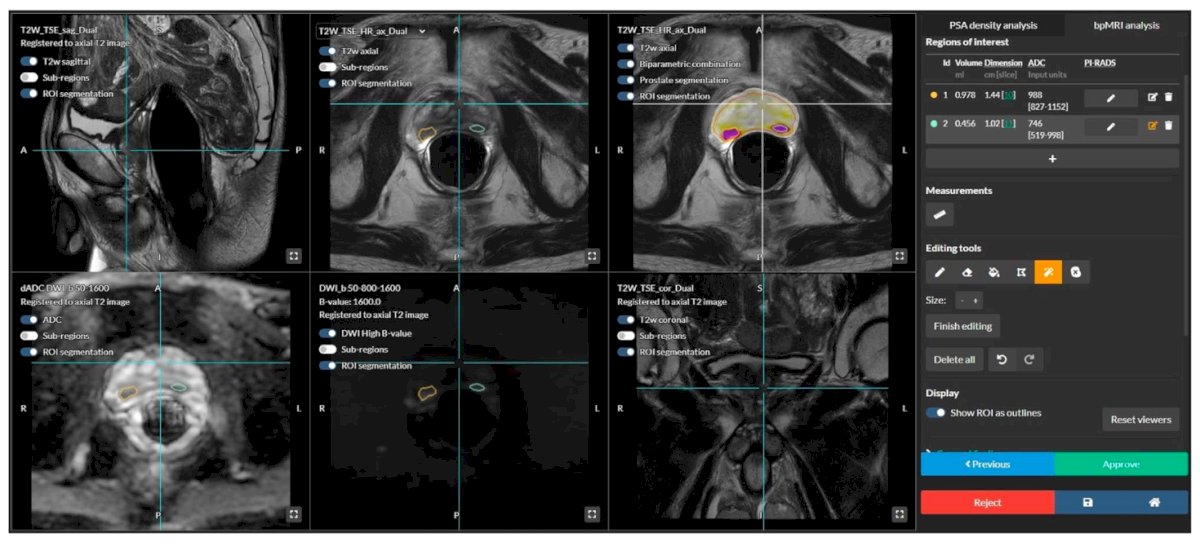
Figure: Quantib Prostate interface
- Department of Urology, Singapore General Hospital, Singapore, Singapore.
- National Cancer Centre Singapore, Singapore, Singapore.
- Department of Urology, Sheffield Teaching Hospitals NHS Foundation Trust, Sheffield, UK.
- Department of Urology, Duke University School of Medicine, Durham, NC.