|
|
|
|
|
|
|
PEER-TO-PEER CLINICAL CONVERSATIONS |
|
|
|
|
|
|
CYP17-Independent Androgen Biosynthesis Pathway Explored in Prostate Cancer
|
|
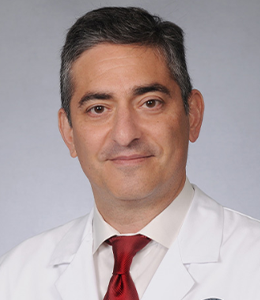
Nima Sharifi, MD
|
| Nima Sharifi describes a CYP17-independent androgen biosynthesis pathway utilizing CYP51A1 and oxysterols. The canonical pathway requires CYP11A1 and CYP17A1 to remove cholesterol side chains stepwise, but CYP51A1 removes eight carbons at once from dihydroxycholesterol.
|
|
|
|
|
|
|
|
|
|
|
|
|
EZH2 Inhibition Combined with ARPI Evaluated in Patients with Castration-Resistant Prostate Cancer
|
Nobuaki Matsubara, MD
Neeraj Agarwal speaks with Nobuaki Matsubara about phase one results for mevrometostat, an EZH2 inhibitor added to a continued ARPI backbone in patients with castration-resistant prostate cancer who had progressed on enzalutamide plus abiraterone or abiraterone alone.
|
|
|
|
|
|
|
|
|
|
|
|
Discussion on Biomarker Selection for Immunotherapy in Prostate Cancer
|
Michael Carducci, MD, and Tian Zhang, MD, MHS
Oliver Sartor hosts Michael Carducci and Tian Zhang to discuss immunotherapy biomarkers in prostate cancer. The conversation centers on mismatch repair deficiency, microsatellite instability high, and tumor mutational burden high, rare biomarkers found in less than 2% of prostate cancers but associated with dramatic responses to pembrolizumab.
|
|
|
|
|
|
|
|
|
|
|
| Mevrometostat in Combination with Enzalutamide in Patients with mCRPC Previously Treated with Abiraterone Acetate: The Phase 3, Randomized MEVPRO-1 Study
|
| Neeraj Agarwal, MD, FASCO
|
| Neeraj Agarwal presented the phase 3 MEVPRO-1 trial, evaluating EZH2 inhibitor mevrometostat + enzalutamide versus enzalutamide or docetaxel monotherapy in ~600 patients with mCRPC post-abiraterone progression. The study addresses ARPI cross-resistance by targeting EZH2-mediated mechanisms, with primary endpoint radiographic PFS by blinded central review and secondary endpoints including OS and safety.
|
|
|
|
|
|
| Why Are Germline and Somatic Alterations in Prostate Cancer Important?
|
| David Olmos, MD, PhD
|
| David Olmos demonstrated that germline/somatic BRCA1/2 and select HRR alterations confer poor prognosis across mHSPC/mCRPC regardless of volume, with somatic > germline prevalence and no ARPI/docetaxel differential in BRCA.FANCA/CDK12 mimic BRCA aggressiveness, while ATM/CHEK2 do not; therapeutic implications include PARP sensitivity, family cascade testing.
|
|
|
|
|
|
| Tumor Suppressor Genes in Prostate Cancer – Currently Prognostic, but Soon to Be Predictive?
|
| Evan Yu, MD
|
| Evan Yu showed that PTEN, TP53, and RB1 alterations define aggressive prostate cancer across stages, with combined loss driving AR-independent/visceral/aggressive variant phenotypes favoring platinum+taxane chemo. Currently prognostic, emerging predictive via ongoing biomarker trials. Molecular stratification is essential for optimizing chemo/targeted combos.
|
|
|
|
|
|
| How to Optimize Germline and Somatic Testing in Prostate Cancer?
|
| Niven Mehra, MD, PhD
|
| Niven Mehra showed that tumor NGS panels efficiently screen HRR germline variants, supporting broad somatic testing in mPCa with confirmatory germline for guideline hits. Complementary pathways optimize efficiency while addressing false-negatives, avoiding family history under-referral. Tumor-only not yet replacement for germline, pending comprehensive panels/prospective data.
|
|
|
|
|
|
| Trial Design and Objectives for Prostate Cancer: Recommendations from the Prostate Cancer Clinical Trials Working Group 4 (PCWG4)
|
| Andrew Armstrong, MD, PhD
|
| Andrew Armstrong showed that PCWG4 updates trial design recommendations to incorporate PSMA-PET phenotyping, genetic subtyping, and patient-centric states, standardizing eligibility, imaging rPFS, and endpoints like ctDNA/PROs. Key changes address prior therapy exposure, biomarker integration, and serial PSMA-PET reassessment intervals for precise benefit assessment in modern landscapes.
|
|
|
|
|
|
|
|
|
|
|