|
|
|
|
|
|
|
Highlights from the 36th Annual EAU Virtual Congress |
|
|
|
| Joint Session of the EAU and the APCCC |
|
| Gaps in the Evidence: Optimal Treatment for cN1 Patients |
| Ricardo Pereira Mestre, MD; Alberto Briganti, MD, Ph.D.; Piet Ost, MD, Ph.D.; Karim Fizazi, MD, Ph.D., Peter Albers, MD |
| The European Association of Urology (EAU) 2021 Virtual Meeting included a joint session of the EAU and the Advanced Prostate Cancer Consensus Conference and a discussion regarding current gaps in the evidence, specifically optimal management of cN1 patients. Participants in this discussion included Drs. Ricardo Mestre, Alberto Briganti, Piet Ost, Karim Fizazi, and Peter Albers. |
|
|
|
|
|
| Gaps in the Evidence: Adjuvant Versus Early Salvage Radiotherapy |
| Derya Tilki, MD; Gert De Meerleer, MD, Ph.D.; Alberto Bossi, MD; Arnulf Stenzl, MD |
| In this discussion, Drs. Derya Tilki, Gert De Meerleer, Alberto Bossi, and Arnulf Stenzl. discuss adjuvant versus early salvage radiotherapy. recent publications of the RAVES, RADICALS, and GETUG-AFU 17 trials, in addition to the ARTISTIC collaborative meta-analysis, have certainly tipped the favor towards early salvage radiotherapy given the similar efficacy, low/no risk of overtreatment, and decreased side-effects of adjuvant treatment. |
|
|
|
|
|
| Controversies in Onco-Urology: Joint Session of ESOU, ERUS, ESMO, ESTRO |
|
| Radiotherapy After Radical Prostatectomy in the PSMA-PET Era |
| Alberto Bossi, MD |
| Alberto Bossi discussed radiotherapy after radical prostatectomy in the PSMA-PET era. Adjuvant radiotherapy is defined as immediate postoperative radiation in the case of extraprostatic extension, positive margins, seminal vesicle infiltration, high Gleason score, or pN+ disease. Salvage radiotherapy is defined as a wait-and-see policy in that radiation is only given in the case of a rising postoperative PSA. |
|
|
|
|
|
| Evolving Landscape of First-Line Systemic Treatment in Metastatic Renal Cell Carcinoma |
| Laurence Albiges, MD, Ph.D. |
| Laurence Albiges discussed the evolving landscape of first-line systemic treatment in metastatic renal cell carcinoma (mRCC) at the European Association of Urology’s (EAU) 2021 annual meeting’s controversies in onco-urology session. Dr. Albiges started by highlighting the new guidelines adapted from the EAU and ESMO guidelines for RCC, using the IMDC risk classification to select treatment options. |
|
|
|
|
|
| There Is No Role for Radical Cystectomy in cT0 After Neoadjuvant Chemotherapy
|
| Alexandra Masson-Lecomte, MD, Ph.D.
|
| Alexandra Masson-Lecomte discussed that there is no role for radical cystectomy in cT0 disease after neoadjuvant chemotherapy. Dr. Masson-Lecomte noted that up to 5-15% of patients will have T0 disease after TURBT alone, which increases to 25-38% after MVAC after neoadjuvant chemotherapy based an analysis of the Nordic I, Nordic II, SWOG, and MRC trials.
|
|
|
|
|
|
|

|
|
|
|
| There Is a Role for Radical Cystectomy in cT0 After Neoadjuvant Chemotherapy |
| J. Alfred Witjes, MD, Ph.D. |
| J. Alfred Witjes discussed that there is a role for radical cystectomy in cT0 disease after neoadjuvant chemotherapy. Dr. Witjes notes that chemotherapy is insufficient as curative therapy in bladder cancer, with the AUA guidelines stating that clinicians should perform radical cystectomy as soon as possible following completion of and recovery from neoadjuvant chemotherapy. Based on the EAU guidelines, there is a strong recommendation for not offering chemotherapy alone as primary therapy for localized bladder cancer. |
|
|
|
|
|
| Optimal Timing of Perioperative Systemic Therapy for High-Risk Upper Urinary Tract Cancer |
| Cedric Poyet, MD, PD Dr. med |
| The Controversies in Onco-Urology session at the European Association of Urology 2021 virtual annual meeting included a presentation by Dr. Cedric Poyet who discussed the optimal timing of perioperative systemic therapy for high-risk upper tract urothelial carcinoma. Dr. Poyet notes that the definition of high-risk upper tract urothelial carcinoma includes cM0, pT2-T4 pN0-N3 or pTanyN1-N3, and high-grade disease. |
|
|
|
|
|
| Optimal Timing of Perioperative Systemic Therapy for High-Risk Upper Urinary Tract Cancer: Adjuvant |
| Nadine Houede, Ph.D. |
| Nadine Houede discussed the adjuvant approach to the optimal timing of perioperative systemic therapy for high-risk upper tract urothelial carcinoma. Dr. Houede notes that upper tract urothelial carcinoma makes up 5% of urothelial carcinomas, with 50-60% comprising the pyelocaliceal location, and 60% diagnosed at an invasive stage of the disease. |
|
|
|
|
|
| Detection of Recurrence and Salvage Treatment Options after Primary Treatment for Prostate Cancer - Poster Session |
| A Prospective Study Assessing the Post-Prostatectomy Detection Rate of a Presumed Local Failure at mpMRI with 18F-Choline, 64Cu-Cl2 or 64Cu-PSMA PET/CT |
| Maria Ferriero |
| In this presentation, Maria Ferriero discussed a prospective study assessing post-prostatectomy detection rate of presumed local failure at mpMRI with 18F-choline, 64Cu-Cl2 or 64Cu-PSMA PET/CT. 64Cu-Cl2 or 64Cu-PSMA PET/CT are novel tracers in the assessment of patients that may be candidates for salvage radiotherapy with a presumed local recurrence at mpMRI after radical prostatectomy. |
|
|
|
|
|
| 68Ga-PSMA PET/CT for Recurrent Prostate Cancer After Radical Prostatectomy: What’s Next? Analysis from a Single, High Volume Tertiary Referral Center |
| Daniele Robesti, MD |
| Daniele Robesti discusses 68Ga-PSMA PET/CT for recurrent prostate cancer after radical prostatectomy. Use of 68Ga-PSMA PET/CT is recommended for prostate cancer re-staging in patients with either PSA persistence or biochemical recurrence after radical prostatectomy. Although this imaging modality is characterized by high sensitivity even at low PSA values, its prognostic implications, as well as the patterns of subsequent progression, have been poorly addressed. |
|
|
|
|
|
| Identification of the Best Candidates for PSMA PET/CT Among Patients Experiencing Biochemical Recurrence After Radical Prostatectomy: A New Tool to Optimize of Patient Selection |
| Giorgio Gandaglia, MD |
| Giorgio Gandaglia discussed the identification of the best candidates for PSMA PET/CT among those experiencing a biochemical recurrence after radical prostatectomy at the European Association of Urology (EAU) 2021 annual meeting’s detection of recurrence and salvage treatment options after primary treatment of prostate cancer session. |
|
|
|
|
|
| Long-Term Validation on the Impact of PSMA-PET on Metastasis-Free Survival in a Large Salvage Radiotherapy Cohort |
| Christoph Wurnschimmel, MD |
| Christoph Wurnschimmel discussed long-term validation on the impact of PSMA-PET on metastasis-free survival (MFS) in a large salvage radiotherapy cohort. Earlier studies focusing on the impact of PSMA-PET imaging for treatment planning prior to salvage radiotherapy for PSA recurrence after radical prostatectomy suggested a high response rate in PSMA negative findings as opposed to PSMA positive findings. However, most available literature either only reported short-term follow-up or did not address long-term MFS. |
|
|
|
|
|
| Intraprostatic Recurrences on PSMA PET/CT After Prostate Whole Gland Radiotherapy: Is Histological Confirmation Necessary?
|
| Henk B. Luiting, MD
|
| Henk Luiting discussed the utility of histological confirmation for intraprostatic recurrences on PSMA PET/CT after prostate whole gland radiotherapy at the European Association of Urology (EAU) 2021 annual meeting. Patients with an intraprostatic recurrence after radiotherapy can be considered for salvage therapy, however, the EAU guidelines recommend obtaining histological confirmation before salvage therapy. This recommendation, however, does not consider the diagnostic accuracy of PSMA PET/CT.
|
|
|
|
|
|
|
|
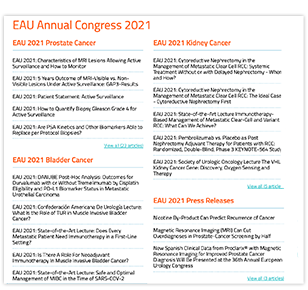
| To view our full coverage of the 2021 EAU Virtual Congress, visit the Conference Coverage section on UroToday.com
|
|
|
|
|
|
|
 |
|
|
|

|
|
|
|
|
|