

(UroToday.com) The 2026 European Association of Urology (EAU) annual meeting featured an advancing prognostics and therapeutics in metastatic prostate cancer session and a presentation by Dr. Rodrigo España Navarro discussing optimization and timing of docetaxel after androgen receptor pathway inhibitor therapy in metastatic castration resistant prostate cancer (mCRPC). Androgen receptor pathway inhibitors have become a standard of care for advanced prostate cancer due to their proven efficacy and safety profile.
While docetaxel efficacy is well established and no treatment has demonstrated superiority over docetaxel in unselected mCRPC patients, only a decreasing proportion of patients receive docetaxel after first-line androgen receptor pathway inhibitor. The optimal timing to initiate docetaxel following an androgen receptor pathway inhibitor remains uncertain, as most predictive models rely on static baseline characteristics without incorporating variables reflecting prior disease evolution. Thus, Dr. España Navarro and colleagues aimed to derive and validate a prognostic tool to predict progression-free survival and overall survival with docetaxel, capturing individual tumor behavior and guiding optimal treatment sequencing.
To build the model, mCRPC patients from the PROREPAIR-B trial1 treated with androgen receptor pathway inhibitors followed by docetaxel were selected for the derivation cohort (n = 111). Patients from PROSTAC (NCT02362620), PROSABI (NCT02787837), and/or PROSENZA (NCT02922218), not included in PROREPAIR-B but treated with androgen receptor pathway inhibitors followed by docetaxel, were used as the validation cohort (n = 243). Baseline characteristics at androgen receptor pathway inhibitor initiation, type and timing of response and/or progression to androgen receptor pathway inhibitors, and established prognostic variables at docetaxel initiation were collected. All variables underwent univariate Cox regression for progression-free survival and overall survival in the derivation set. Significant variables were then subjected to least absolute shrinkage and selection operator (LASSO) analysis to identify the most relevant predictors. Individual risk scores for progression-free survival and overall survival were generated using multivariate Cox models, allowing patient stratification into low- and high-risk groups and construction of a prognostic nomogram. External validation was performed in the independent cohort, and predictive accuracy was assessed using Harrell’s C-index.
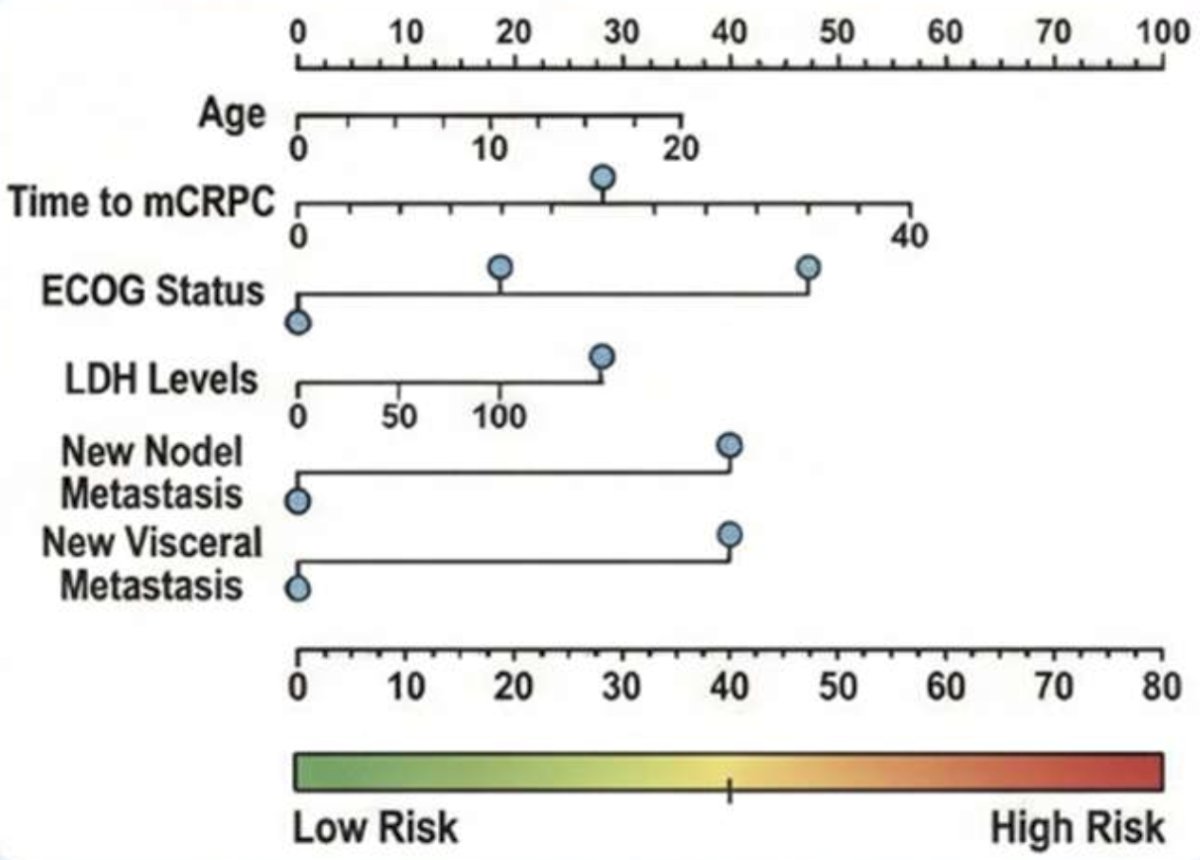
The LASSO method identified six variables independently associated with progression-free survival and overall survival:
- Age at diagnosis
- Time to mCRPC
- Development of new nodal metastases during the androgen receptor pathway inhibitor
- Development of new visceral metastases during the androgen receptor pathway inhibitor
- Elevated LDH
- ECOG performance status at docetaxel initiation
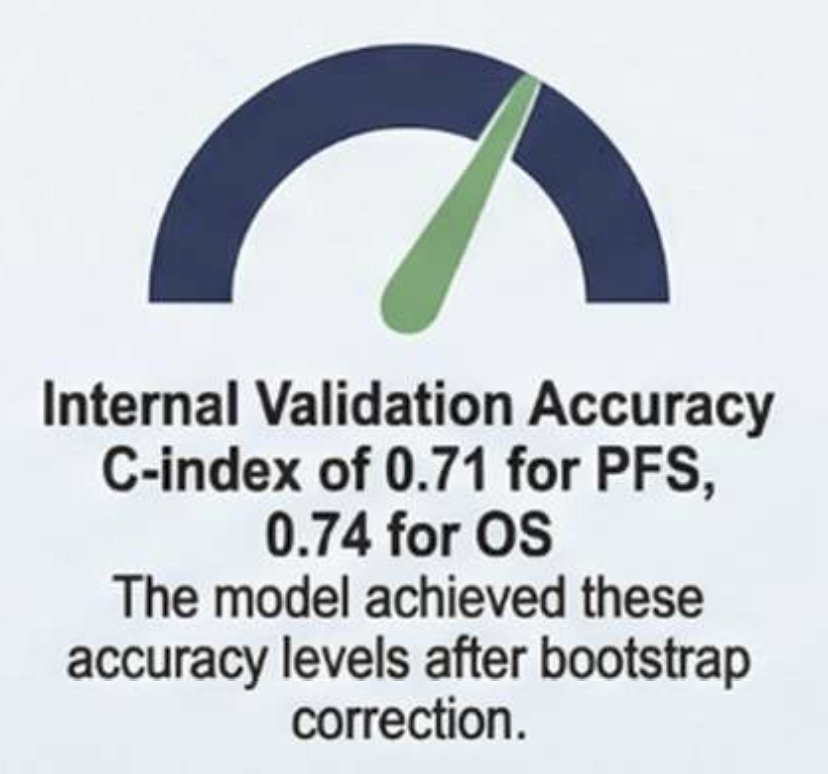
After bootstrap correction for internal validation, the progression-free survival and overall survival models showed a C-index of 0.71 (95% CI, 0.66–0.77) and 0.74 (95% CI, 0.68–0.80), respectively:
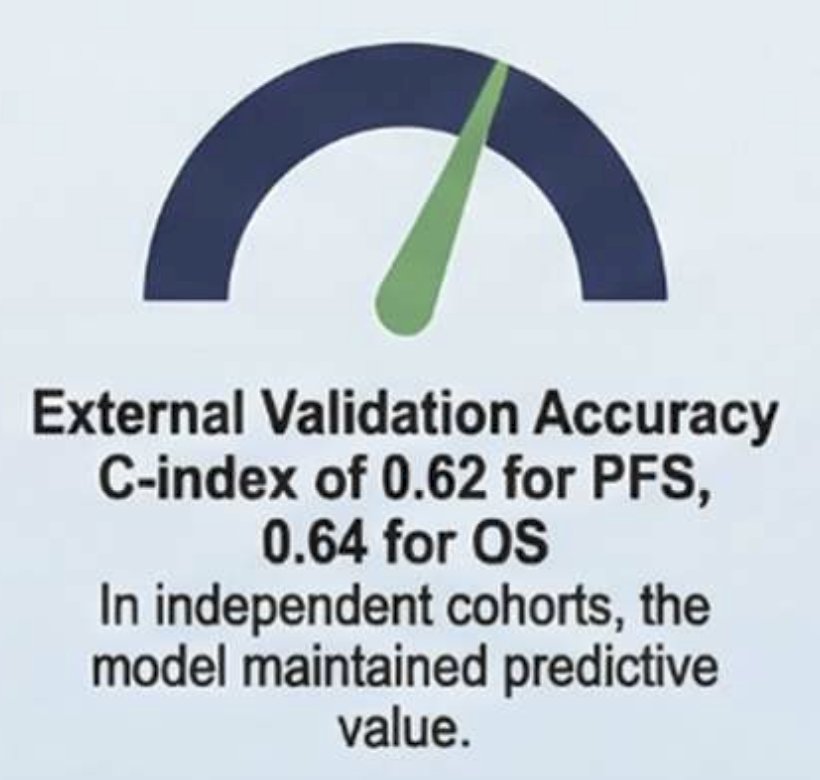
External validation yielded a C-index of 0.62 (95% CI, 0.60–0.70) and 0.64 (95% CI, 0.60–0.70) for progression-free survival and overall survival, respectively:
The following prognostic nomogram stratifies patients into low- and high-risk groups, providing an accessible way to estimate docetaxel benefits based on individual tumor behavior:
Dr. España Navarro concluded his presentation discussing optimization and timing of docetaxel after androgen receptor pathway inhibitor therapy in mCRPC with the following take-home points:
- This validated prognostic model provides a practical and accessible tool for clinicians to estimate the potential benefit of docetaxel following an androgen receptor pathway inhibitor, based on six key variables
- It may support individualized treatment sequencing, particularly in settings where precision oncology tools are unavailable
Presented by: Rodrigo España Navarro, MD, Regional University Hospital, Málaga University, Andalucia, Spain
Written by: Zachary Klaassen, MD, MSc – Urologic Oncologist, Associate Professor of Urology, Georgia Cancer Center, Wellstar MCG Health, @zklaassen_md on Twitter during the 2026 European Association of Urology (EAU) Annual Meeting, London, United Kingdom, Fri, Mar 13 – Mon, Mar 16, 2026.
Reference: